Low-water landscaping is a direct and practical approach to this. Plants, materials, and irrigation techniques are chosen with specific regard to arid conditions, so that the garden can be maintained with much less water than a conventional lawn arrangement. The following ideas can be used in both low-water landscaping front yards and low-water backyard landscaping, and can be adapted to the plots of villas of various sizes located in Dubai and the UAE in general.
Low-Water Landscaping Ideas for UAE Homes
The following are some real-world design concepts that can assist you in minimizing water consumption and still have a functional and aesthetically balanced outdoor space.
1. Replace Grass with Gravel Beds
One of the largest water consumers in a UAE garden is often a large lawn. Natural grass is also a big maintenance overhead that needs constant watering, mowing, fertilizing, along with pest control. Due to this, a lot of homeowners are now opting to either replace all or part of their lawn with decorative gravel.
Gravel comes in various sizes as well as colors, such as white quartz, beige sandstone, charcoal pebbles, plus it can be laid in patterns or between the planting beds. After installation, minimal maintenance is needed. The heat is reflected and not absorbed, and the water of the rain is left to drain naturally into the soil.
A gravel-based design with limited structured plant placement is commonly considered a clean and dependable solution that retains its appearance over the year without irrigation, in front yards.
2. Use Drought-Tolerant Plants
This forms the base of any low-water landscape design. Drought-tolerant plants are naturally developed to endure with scarce water. The moisture is either stored in the leaves, deeper root systems are formed, or the plant goes into a dormant state when the moisture is extremely dry.
There are several types of plants that have been extensively utilized in the UAE. Bougainvillea is commonly chosen on the basis of its rapid growth and bright color, and because it needs little water once established. Desert Rose is a good plant that can be used in full sun. Agave and aloe vera are plants that can store water and need minimal irrigation. Other plants that are commonly used in Dubai landscapes include lantana, Ghaf trees, and ornamental grasses.
In the case of front yard low-water landscape ideas, a stratified approach is commonly used, i.e., low succulents, mid-height shrubs, and one or two feature trees. This is done by creating depth without necessarily having complicated watering systems.
3. Install a Drip Irrigation System
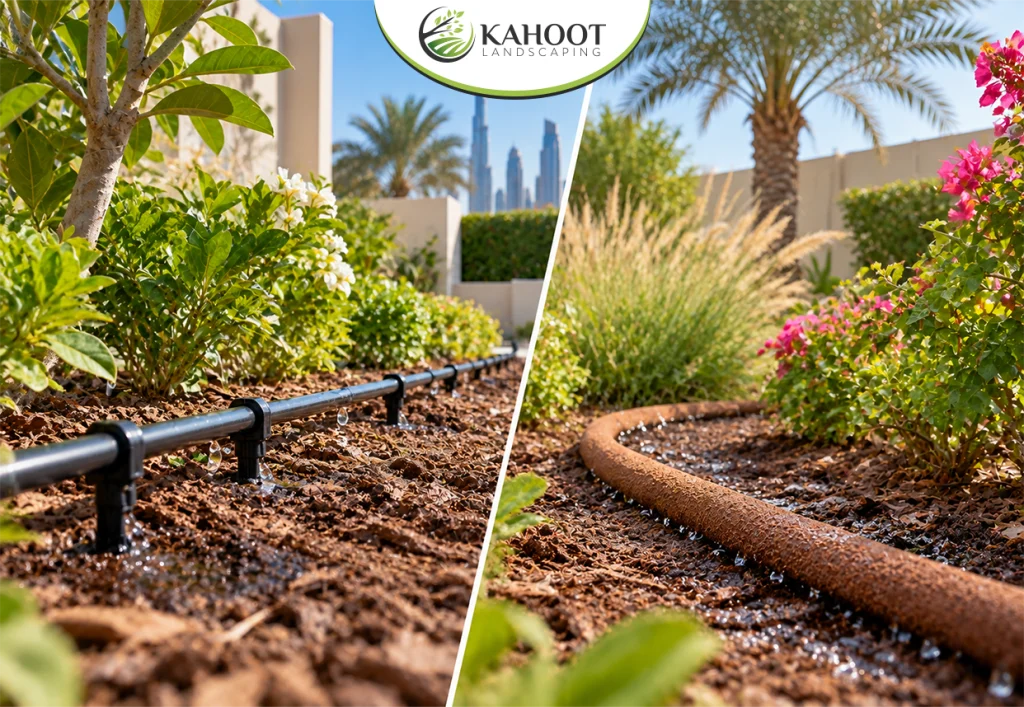
Even plants that are resistant to drought need to be watered under control, particularly during the summer season. A drip irrigation system is a system that applies water to the roots in small and measured amounts. In comparison to conventional sprinklers, a lot less water is wasted to evaporation.
These systems are typically linked to timers and can be changed in accordance with the season. Some of these systems also have soil moisture sensors, which means that watering is automatically decreased when there is already enough moisture in the soil.
To the majority of the UAE gardens, this is regarded as one of the most effective upgrades. Constant watering minimizes water usage, manual labor, and the overall health of the plants is usually better.
4. Add Decomposed Granite Pathways
Decomposed granite is a natural substance that is made out of weathered rock. It is very fine and compact in texture and lies well underfoot. It is easy to drain and does not need water to sustain it, hence it is appropriate to the UAE conditions.
The pathways may be laid in either a straight or a curved pattern based on the type of garden. To fix the material in place and provide a defined finish, borders are commonly added with the use of stone or metal edging.
A pathway constructed of decomposed granite, along with the use of drought-tolerant planting, makes the front yard of the house welcoming without making the water usage more intensive.
5. Create a Rock Garden
The primary design elements in rock gardens are stones, gravel, alongside boulders. The plants are not positioned to cover the whole space but to be placed between these elements. This style is more natural in the UAE, as it is a reflection of the surrounding landscape.
Smaller stones are used to delineate planting areas, while focal points are usually large stones. Open spaces are filled with gravel to complete the design.
Succulents, cacti, together with ground-cover plants are placed in soil pockets.
When it is done, it needs very little watering. It is also easy to maintain, and this makes it a good option to use both in the front and the back yard.
6. Use Mulch Around Plant Beds
Mulch is used as a top layer on soil. The primary purpose of it is to minimize the evaporation of water, which in turn helps plants to keep moisture longer. The growth of weeds is also minimized, along with the soil temperature is maintained at a more constant level.
This is of particular concern under UAE conditions, especially in summer. Organic mulch, e.g., bark or maybe wood chips, decomposes slowly as well as improves the quality of soil. The inorganic ones, such as gravel, are more durable plus can be used in hot weather.
An average of 5 to 8 cm of layer is typically applied, and a significant decrease in water consumption is often realized.
7. Design with Raised Planting Beds
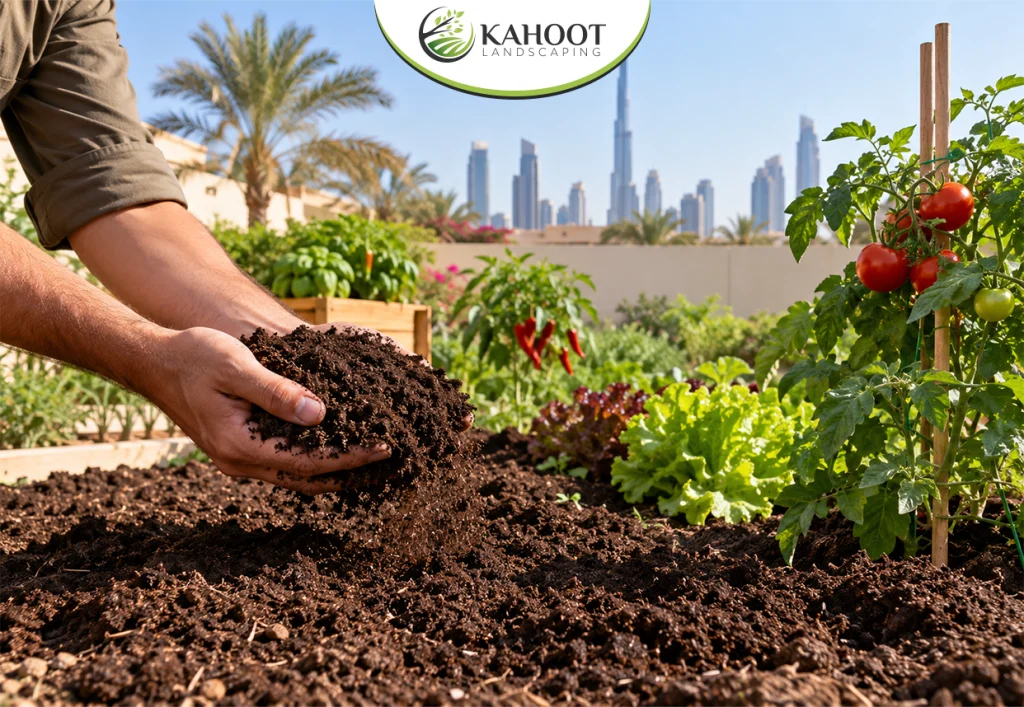
Raised beds enable the soil composition to be better controlled. It can be a combination of sand, compost, and moisture-retaining substances, which makes plants more efficient in retaining water than natural ground soil.
Since the area of planting is enclosed, drip irrigation can be used more specifically while water is channeled to precisely where it is required. This also minimizes waste.
Raised beds are commonly used along boundaries or around patios. You can also add structure to the garden without consuming a lot of water.
8. Plant Native and Regionally Adapted Trees
Trees are also significant in cooling down the heat in a garden. Shade is offered, and this decreases the temperature of other plants and decreases water requirements.
Native species tend to be preferred in the UAE. Date palms are well known and need little attention once they are planted. Another tough choice is the ghaf trees, which are known to grow well in dry soil. Olive trees are also widely employed, as they can easily adapt to the local climate.
A single tree strategically placed can improve the general atmosphere of the garden.
9. Use Artificial Turf for Small Lawn Areas
Where artificial turf is still required, in regions where the desired green surface is still required, artificial turf is a viable option. It does not need to be watered, mowed or fertilized. The turf that is of high quality and is exposed to UV rays will retain it looks over a period of several years.
It can be applied in small areas like play areas or sitting areas as opposed to the whole garden. This maintains low maintenance and yet offers a soft and green surface.
10. Design Hardscape Zones for Outdoor Living
Hardscape features are patios, pathways, seating areas, and stonework. The more of these features that are added, the less area is needed to be irrigated.
A patio that is paved with stone or porcelain, with shaded seating, can provide a usable outdoor space with limited water requirements. Plants are typically placed in containers, where it is easier to regulate watering.
In the case of UAE homes, this strategy is effective, particularly when the weather is cooler, and outdoor usage is higher.
Comparison: Low Water Landscaping Option
| Characteristic/Component | Water Usage | Maintenance Level | Best For |
| Gravel Beds | Very Low | Very Low | Front yards, open spaces |
| Drought-Tolerant Plants | Low | Low | All garden types |
| Drip Irrigation | Controlled | Low | Efficient watering systems |
| Rock Gardens | Very Low | Very Low | Decorative areas, corners |
| Artificial Turf | None | Very Low | Play areas, seating zones |
| Hardscape Areas | None | Minimal | Patios, outdoor living space |
What to Consider Before Starting
There is no universal answer to low-water landscape design ideas. The final design is usually influenced by the size of the plot, soil conditions, available sunlight, and how the space will be used daily.
Front yards are usually made to look good, and thus, gravel, organized planting, and defined layouts are desirable. On the other hand, backyards are more practical areas, where comfort and functionality are equally vital.
This can be achieved by proper planning at the beginning, such as soil preparation, plant selection, and irrigation setup, which will help avoid unnecessary maintenance in the future and will guarantee better long-term outcomes.
Low Water Landscaping Services in Dubai
Low water landscape designs are designed and installed in residential properties throughout Dubai and the UAE at KLG. Every project is designed according to the conditions of the site, so that the garden would be aesthetically pleasing and at the same time, the amount of water used would be minimal.
As an experienced landscaping company in Dubai, design, supply, installation, along with maintenance are handled as a complete service. You may visit us through the website to discuss projects or to conduct site assessments.
Final Words!
Low-water landscaping provides an effective solution to the maintenance of attractive outdoor spaces in the UAE and keeping water consumption and maintenance low. Gardens can be made to be operational and aesthetically balanced throughout the year by combining drought-tolerant plants, efficient irrigation systems and durable materials. Depending on space and use, it can be modified, but the emphasis remains on simplicity and sustainability. When well planned at the outset, it leads to a more sustainable outdoor setting, which is more easily managed within the local climatic conditions.
Frequently Asked Questions
1. What is low-water landscaping?
It is a design strategy in which plants, materials, as well as irrigation techniques are chosen in dry climates. The aim is to cut down on the amount of water consumed, yet have an appealing outdoor environment.
2. Which plants are best for low-water landscaping in the UAE?
The plants that are mostly used are Bougainvillea, Desert Rose, Agave, Aloe Vera, Lantana, Date Palm, and Ghaf trees.
3. Is low-water landscaping suitable for front yards in Dubai?
Yes, low-water front yard ideas are common and can be applied to designs of the front yard. Gravel, drought-tolerant plants, and formal designs contribute to the appearance with minimal maintenance.
4. How much does low water landscaping cost in Dubai?
Prices differ with size, materials, and complexity of design. Less elaborate designs with gravel and planting are typically less expensive than complete redesigns with hardscape elements.
5. Can a landscaping company in Dubai help design a low-water garden?
Yes. An expert firm will be able to evaluate the location, suggest appropriate vegetation, and create an effective plan. This typically leads to improved plant survival and water efficiency in the long term.